The term "natural vegetation" refers to a group of plants that have been undisturbed for an extended period, enabling each species to adapt to their specific climate and soil conditions to the fullest extent possible.
Classification of Forests
As per FSI the forest cover is classified broadly into 4 classes
| Very dense Forest |
All Lands with tree cover (Including mangrove cover) of canopy density of 70% and above |
| Moderate Dense Forest |
All lands with tree cover (Including mangrove cover) of canopy density between 40% and 70% above |
| Open forest |
All lands with tree cover (Including mangrove cover) of canopy density between 10% and 40% |
| Scurb |
All forest lands with poor tree growth mainly of small or stunted trees having canopy density less than 10 percent
|
| Non Forest | Any area not included in the above classes |
Some facts about Indian forests
- India is ranked 10th in world, with 24.4% of land area under forest and tree cover, even though it accounts for 2.4% of the world surface area
- Fifteen states/UTs have above 33% of geographical area under forest cover
- Silent Valley is a lush tropical forest in the Palakkad district of Kerala, India.
- Valley of Flowers is situated in the West Himalayas of Uttarakhand state and is recognized for its endemic alpine flowers and diverse flora.
- Both locations are distinct in terms of their geographic locations and unique flora.
- Andhra Pradesh (including Telagana), Uttarakhand, Kerala, Tamilnadu, West Bengal and Maharashtra have large percentages of reserved forests
- The Sundarbans is the largest mangrove forest in the world, situated in Bangladesh and West Bengal, India.
- As per the 2011 census, A&N Islands (86.93%) and Sikkim (82.31%) have the highest forest area as a percentage of geographic area.
- Madhya Pradesh has the largest area under permanent forests.
- State records indicate that the forest area covers 23.28% of the total land area of the country.
Forest area vs Forest cover-
- The forest area is the area notified and recorded as the forest land irrespective of the existence of trees, while the actual forest cover is the area occupied by forests with canopy
- The former is based on the records of the State Revenue Department, while the latter is based on aerial photographs and satellite imageries
According to India State of Forest Report 2011
- The actual forest cover in India is only 21.05 per cent. Of the forest cover, the share of dense and open forests are 12.29 and 8.75 per cent respectively
- Lakshadweep has zero per cent forest area; Andaman and Nicobar Islands have 86.93 per cent
- States with less than 10 per cent of the forest area- Rajasthan, Gujarat, Punjab, Haryana and Delhi
- States with 10-20 per cent forest area- Tamil Nadu and West Bengal
- The area under forest cover is 20-30 per cent - In Peninsular India, excluding Tamil Nadu, Dadra and Nagar Haveli and Goa,
- The north-eastern states have more than 30 per cent of the land under forest
Types of Forests
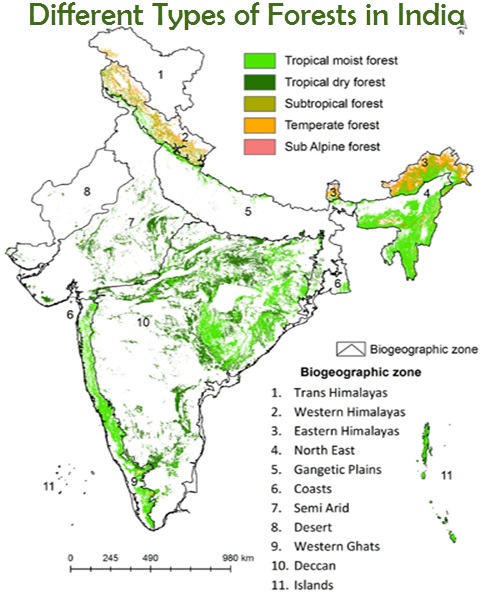
1.Moist Tropical Evergreen Vegetation
- These are the tropical rain forests which are further divided into two sub-types on the basis of their characteristics as under:
(a) The Wet Tropical Evergreen -
- Occurs in areas with more than 300 cm of annual rainfall and a short dry season
- Found in southern parts of the Western Ghats of Kerala and Karnataka
- Also present in the North-eastern Hills and similar to equatorial vegetation
- Has been severely reduced due to excessive tree cutting
- Trees do not have a specific time for shedding leaves, flowering, and fruiting
- These forests maintain a green appearance throughout the year.
- The number of vegetal species per unit area is too large to exploit them commercially.
- Undergrowth is very dense and thick. Grass is almost absent.
- The wood of these trees is very hard and heavy to work with.
Example-
- Mahogany, cinchona, bamboos and palms are typical species of plants found in these forests.
(b) Moist Tropical Semi-evergreen
- The semi evergreen forests are found in the less rainy parts of these regions.
- This type of vegetation is found on the Meghalaya plateau, Sahyadris and Nicobar Islands.
- This vegetation is confined to areas receiving an annual rainfall of about 250 to 300 cms.
- The vegetation cover is less dense than the wet evergreen forests
- Timber of these forests is fine textured and of good quality.
Examples-
- Rosewood, aini and telsur are important trees in Sahyadris, champa. joon and gurjan in Assam and Meghalaya and ironwood, ebony and laurel grew in other regions.
2.Moist Tropical Deciduous Vegetation
- The trees shed their leaves once in a year in dry season
- These are the most widespread forests in India
- They spread over regions which receive rainfall between 70-200 cm.
Area-
- Northeastern states along the foothills of Himalayas, eastern slopes of the Western Ghats and Odisha.
Species
- Teak, sal, shisham, hurra, mahua, amla, semul, kusum, and sandalwood etc. are the main species of these forests
3.Dry Tropical Vegetation
This type of vegetation is divided into two groups as under:
(a) Dry Tropical Deciduous Vegetation
- It is found in regions receiving annual rainfall between 70 to 100 cms.
- Teak is the dominant tree of this type of vegetation
The trees shed their leaves during the long dry season.
Area-
- Parts of Uttar Pradesh, northern and western Madhya Pradesh, parts of Gujarat, Maharashtra, Andhra Pradesh, Karnataka and Tamil Nadu
Examples-
- Tendu, palas, amaltas, bel, khair, axlewood, etc.
(b) Dry Tropical Thorny Vegetation
- It is found in areas receiving annual rainfall less than 70 cms.
Area-
- North and north western parts of India and leeward side of the Sahyadri’s
Examples- Acacia, euphorbias, cactus babool, ber, and wild date palm, khair, neem, khejri, palas etc.
4.The Mountain Vegetation
The mountain vegetation can be classified as the mountain vegetation of Peninsular plateau and the mountain vegetation of the Himalayan ranges.
(a) The Mountain Vegetation of Peninsular Plateau:
Area-
- The high-altitude plateau region encompasses Nilgiri, Annamalai, and Palni hills, Mahabaleshwar in Western Ghats, Satpura, and Maikal hills.
- Open rolling grass plains with undeveloped forests or bushes are present in the area.
- The forests in the region have a dense undergrowth of epiphytes, mosses, and ferns.
Examples-
- Magnolia, laurel, elm are common trees. Cinchona and eucalyptus have been introduced from outside the country.
(b) Himalayan Vegetation
This can be divided into following types:
- Moist Tropical Deciduous forests are found along the foot hills in the Siwaliks, upto the height of 1000 metres.
- The Wet Temperate Evergreen forests are found in the areas lying between 1000 to 3000 metres.
- These are very thick forests of lofty trees
Examples-
- The eastern Himalayan region is mainly dominated by oak and chestnut trees, whereas in the western part, chir and pine trees are prevalent.
- In the lower altitudes, sal trees hold great significance. The height range of 2000 to 3000 metres is characterized by the dominance of deodar, silver fir, and spruce trees.
Dry Temperate Vegetation
- It is found on the higher hilly slopes of this mountain region which has moderate temperatures and rainfall
- This vegetation resembles the Mediterranean vegetation
Examples- Wild olives, acacia are important trees along with hard, coarse and thick savanna grass. Oak and deodar are also found here and there.
Alpine Vegetation
- It is found between the altitude 3000 and 4000 metres.
Examples- Silver fir, juniper, birch, pine and rhododendron are important trees of these forests.
- There is very less Tree cover under this area
5.Littoral and Swamp Forests
- India has a rich variety of wetland habitats.
- About 70 per cent of this comprises areas under paddy cultivation.
- The major mangrove wetlands of India are located along the East Coast of India
- Indian mangrove vegetation covers about 6,749 km2 along the 7516.6 km long coast line, including Island territories- East Coast, about 4700 km (2) West Coast, about 850 km, and (3) Andaman & Nicobar Islands about 1190 km2, with Lakshadweep Atoll.