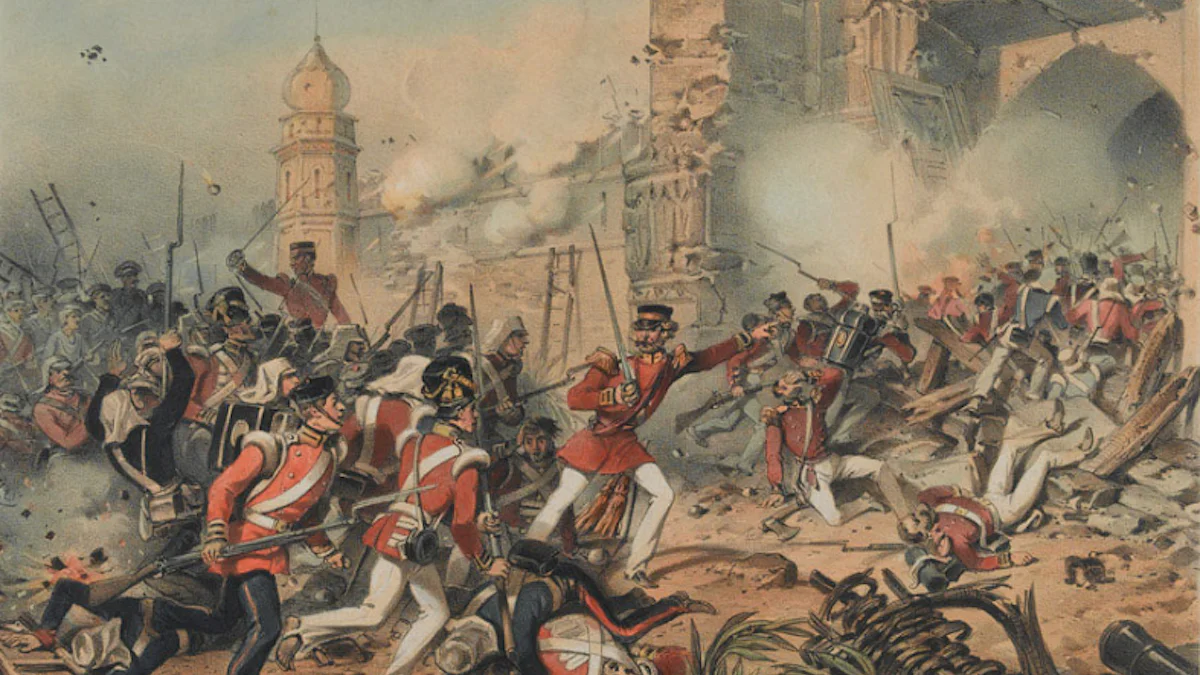
The Revolt of 1857 was a major upheaval against the British Rule in which the disgruntled princes, to disconnected sepoys and disillusioned elements participated.
Background
Revolt of 1857 was not sudden, but the culmination of growing discontent.
- In certain cases, the British could put down these uprisings easily, in other cases the struggle was prolonged resulting in heavy causalities.
- These disturbances and uprising, though did not succeed in uprooting the British power from India, became the precursors of the major Revolt of 1857.
Nature and character of revolt-
The historians have divergent opinion regarding the nature of uprising. The British considered it just a ‘A Military Revolt’ which had neither the leadership of any of the Indian leaders, nor the cooperation of the people. The Indian patriots considered that uprising as National War of Independence. As a whole, there are the main
Following views regarding the nature and character of the Revolt of 1857 A.D.
(1) A Military Revolt
(2) An Attempt for establishing the Mughal Power
(3) Aristocrat Reaction
(4) A Peasant Reaction
(5) A National Revolution
(6) A racial struggle for supremacy between Black and White
(7) A struggled between Oriental and Occidental Civilization and Culture
(8) A National War of Independence
Causes of The Revolt
1. Political Cause
A. Doctrine of Lapse:
- The notable British technique called the Doctrine of Lapse was first perpetrated by Lord Dalhousie in the late 1840s.
- It involved the British prohibiting a Hindu ruler without a natural heir from adopting a successor and, after the ruler died or abdicated, annexing his land.
- A large number of Indian rulers and chiefs were dislodged, thus arousing fear in the minds of other ruling families who apprehended a similar fate.
- Rani Lakshmi Bai’s adopted son was not permitted to sit on the throne of Jhansi.
- Satara, Nagpur and Jhansi were annexed under the Doctrine of Lapse.
- Jaitpur, Sambalpur and Udaipur were also annexed.
The annexation of Awadh by Lord Dalhousie on the pretext of maladministration left thousands of nobles, officials, retainers and soldiers jobless. This measure converted Awadh, a loyal state, into a hotbed of discontent and intrigue.
- Wars and Conquests
- Subsidiary Alliance: The British policy of territorial annexations led to the displacement of a large number of rulers and chiefs. The vigorous application of the policies of Subsidiary Alliance and Doctrine of Lapse angered the ruling sections of the society. The subsidiary alliance of Lord Wellesley, played a major role in British expansion in India. According to this alliance, Indian rulers were not allowed to have their independent armed force
- Suspension of Pension: The Company’s Director were keen to increase their dividends, they wanted the Company’s administration in India to follow economy. That led to the reduction and suspension of pensions of some of the Indian chiefs and who were disposed by the company
2. Administrative Causes:
A. Introduction of New Administrative System:
- The British rule altogether introduced a new system of administration, which was faceless, soulless, and without any human touch. The English officials were not only inaccessible but also arrogant and scornful towards the Indians
B. Exclusion of Indians from Higher Administrative posts
- In the new administrative machinery Indians were excluded from all the jobs both in civil as well as in military departments. All the Higher posts in British administration were kept reserved for the English people to the exclusion of the Indians
C. Loss of Benefits and Privileges
- The Indian aristocrats once enjoyed privileges, both economic and social were now deprived of such privileges by the annexation policy of the East India Company
3. Economic Cause
- In rural areas, peasants and zamindars were infuriated by the heavy taxes on land and the stringent methods of revenue collection followed by the Company.
- Many among these groups were unable to meet the heavy revenue demands and repay their loans to money lenders, eventually losing the lands that they had held for generations.
A. Ruin of the Mercantile Class
- The British deliberately crippled Indian trade and commerce by imposing high tariff duties against Indian goods. On the other hand, they encouraged the import of British goods to India.
- As a result, by the middle of the nineteenth century Indian exports of cotton and silk goods practically came to an end.
- The introduction of new land revenue system in the newly acquired States the English administrators had brought the peasants as well as the British government into direct contact with one another, thus eliminating the middlemen between the two parties.
- In this way, the great Talukdars and Zamindars, who used to collect land revenue before that, were deprived of their income as well as their position.
B. Pressure on Land
- The ruined of Indian Industry and commerce made several people unemployed and lack of alternate occupational avenues drove a large part of urban population to fall back on the village economy.
C. Exploitation on European Plantations
- Due to the Industrial revolution in England, they were in needs of raw material which could not be satisfy from the Industry of England. Therefore, the British settlers in India, monopolized the plantation industries like indigo, jute, tea, coffee etc.
4. Socio - Religious Causes: -
- East India company abolished Sati pratha, child marriage & encouraged widow remarriage, at that time it was considered as a threat to Indian traditions. Britishers wanted Hindus & the Muslim religion to be converted into Christianity.
- According to the Charter Act of 1813 missionaries were permitted to enter the Company's territories in India to propagate their religion and spread Western education. The Christian missionaries took every opportunity to expose the abuses in the Hindu as well as the Islamic religion.
- The missionary society of America established a press at Agra which made every effort to propagate Christianity. The missionaries’ denounced idolatry ridiculed the Hindu gods and goddesses and criticized the philosophy and principals of Hinduism and Islam
- The Influence of Pandits and Maulanas was Reduced
5. Military Causes: -
- Gradual weakening of loyalty in the army
- Disparity in the Indian and British soldiers stationed in India: The disparity between the Indian troops and British troops in India was very high. The number of Indian soldiers were much more in number than the British soldiers.
- Dissimilarity between the salaries of the Indian Soldiers and the British Soldiers
- Ruin of the British in the Afghan War
6. The Immediate Cause: - Greased Cartridges
- With all the causes the immediate cause that infuriated soldiers was when the ‘Enfield’ rifle was introduced. Before this soldier had to carry gun powder & bullets along with their rifles.
- The process of using a gun was time-consuming, Britishers introduced the Enfield rifle gun & cartridge.
- The cartridge was in a cylindrical shape with a knot on top & filled with the perfect amount of gunpowder & bullet in the end.
- Soldiers just had to tear the cartridge & then be ready to use a rifle, this saved a lot of time.
- There was a rumor that aroused that the cartridge was greased with pig & cow fat. The pig is taboo in Muslims & the cow is sacred in the Hindu religion. Indian soldiers refused to use the cartridge & soldiers were also sentenced.
- In March 1857, Mangal Pandey, a sepoy in Barrackpore, had refused to use the cartridge and attacked his senior officers.
- He was hanged to death on 8th April.
- On 9th May, 85 soldiers in Meerut refused to use the new rifle and were sentenced to ten years’ imprisonment.