Climate refers to the average of the weather conditions over a longer period of time. India’s climate is characterized as ‘Tropical Monsoon’ clearly indicating upon it the dominant influence of the country’s latitudes and the monsoon winds.
Regional variations of Indian climate
- The climatic conditions in the southern states of Kerala and Tamil Nadu differ significantly from those in the northern states of Uttar Pradesh and Bihar, despite the fact that all of these regions experience a monsoon-type climate.
Regional variation in Temperature -
- Churu in Rajasthan may record a temperature of 50°C or more on a June day while the mercury hardly touches 19°C in Tawang (Arunachal Pradesh) on the same day
- The temperature difference between day and night in Kerala and the Andaman Islands is typically only around seven to eight degrees Celsius, whereas in the Thar Desert, the temperature can drop significantly at night to as low as 15 to 20 degrees Celsius, even if the daytime temperature was around 50°C.
Regional variations in precipitation-
- The Himalayas experience snowfall, while the rest of the country only gets rain.
- Cherrapunji and Mawsynram in the Khasi Hills of Meghalaya receive over 1,080 cm of rainfall per year.
- Jaisalmer in Rajasthan receives less than 9 cm of rainfall in the same time frame.
- We see there is a decrease in rainfall from East to West in northern plains.
- In spite of these differences and variations, the climate of India is monsoonal in rhythm and character
Factors influencing the climate of India
1. Location and Latitudinal Extent-
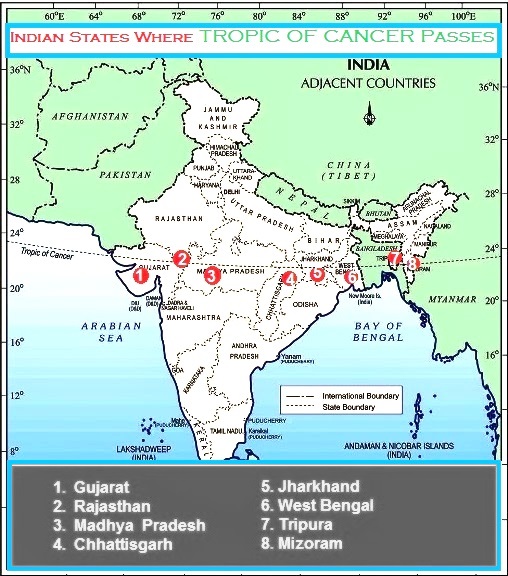
- The Tropic of Cancer runs through India from west to east, cutting through the Rann of Kuchchh in the west to Mizoram in the east.
- Approximately half of India, located below the Tropic of Cancer, falls within the tropical zone.
- The other half of India, situated north of the Tropic, is in the sub-tropical zone.
- Thus, India's climate exhibits features of both tropical and subtropical climates.
2.Distance from the Sea-
- Coastal areas in India have a moderate climate due to their long coastline.
- Inland areas of India experience extreme climates due to their distance from the sea.
- The people of Mumbai and the Konkan coast are not exposed to extreme temperatures.
- On the other hand, cities like Delhi, Kanpur, and Amritsar have significant seasonal changes that affect daily life.
- The weather contrasts in these interior regions are much more pronounced than those in coastal areas.
3.The Northern Mountain Ranges
- The Himalayan ranges shield India from the harsh and arid winds of Central Asia in winter.
- They serve as a potent natural barrier to prevent the rain-laden southwest monsoon winds from traversing the northern boundaries of India.
- The ranges function as a catchment area for the monsoon winds, causing them to lose their moisture within the country.
- This leads to copious rainfall in the Great Plains, while Central Asia remains in the 'rain shadow' of the Himalayas.
4.Physiography
- The physical features influence the air temperature, atmospheric pressure, direction of winds and the amount of rainfall in different parts of the country.
Western Ghats
- The south west Monsoon winds from the Arabian Sea strike almost perpendicular to the Western Ghats and cause heavy rainfall in the western coastal plain and the western slopes of Western Ghats.
- On the contrary, vast areas of Maharastra, Karnataka, Talangana, Andhra Pradesh and Taimilnadu lie in rain shadow or leeward side of the Western Ghat and receive scanty rainfall.
- Manglore, along the coast gets the rain nearly 280 cm whereas Bengaluru receives only 50 cm rainfall.
Aravalli Hills
- It run parallel to the direction of the south -west monsoon winds. As such moisture laden winds pass through Rajasthan without shedding their moisture. This accounts for Rajasthan dry climate.
- Bay of Bengal monsoon also reaches here, when its moisture content becomes less or declines.
The hills of Mehgalaya Plateau
- The hills of Mehgalaya Plateau force the moisture laden winds coming from the Bay of Bengal to shed their moisture before proceeding northwards
- As a result, the south of Assam gets heavy rainfall while the north is comparatively dry
5.Altitude-
- Temperature decreases as altitude increases.
- The mountainous regions are cooler compared to the plain areas due to thin air.
- Agra and Darjiling, located on the same latitude, have contrasting temperatures in January.
- In Agra, the temperature is 16°C while in Darjiling, it is only 4°C.
6.Monsoon Winds
- The sudden change in seasons in India is caused by a complete reversal in wind direction.
- The winds responsible for this change are known as monsoon winds.
- The term 'monsoon' is derived from the Arabic word 'Mousim', which means 'season'.
(a) The Northeast Monsoon and its Effect:
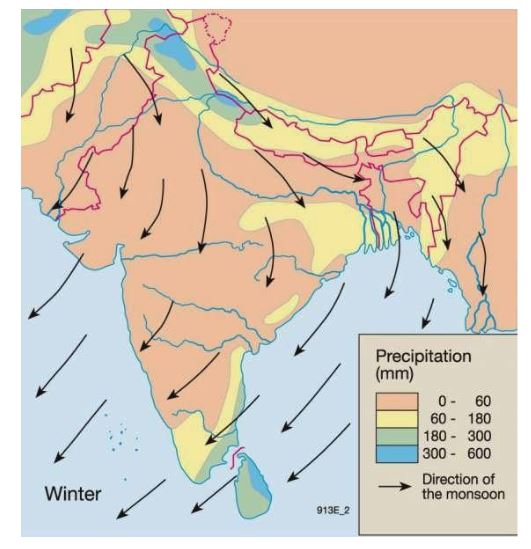
- In winter, weather is affected by high pressure in Northwestern subcontinent.
- Cold dry winds blow from this region towards southern low-pressure areas over water bodies around peninsular India.
- These winds are dry and do not cause rainfall, resulting in cold and dry weather conditions.
- Northeast monsoon winds collect moisture while passing over Bay of Bengal.
- The collected moisture brings rain along Coromandel coast.
(b) The Southwest Monsoon and its Effect :
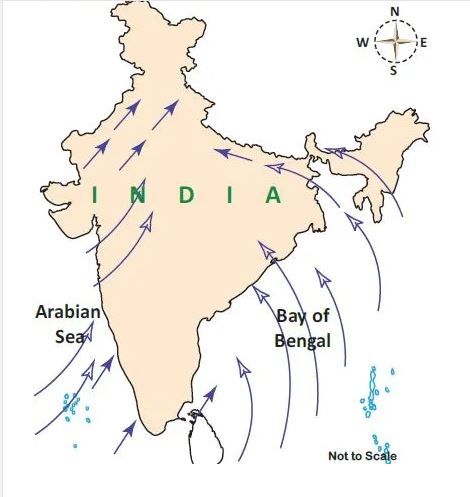
- During summer, the temperature in northwestern parts of India rises significantly.
- This is because of the apparent shift of the sun in the northern hemisphere.
- The shift leads to a reversal of air pressure conditions in northwestern India and surrounding water bodies.
- The Northeast Trade winds are replaced by the Southwest monsoon winds during this time.
- These winds blow over warm water bodies before reaching land and carry moisture with them.
- The moisture in the winds causes widespread rain in most parts of India.
- The rainy season in most parts of the country occurs from June to September and is due to the southwest monsoon.
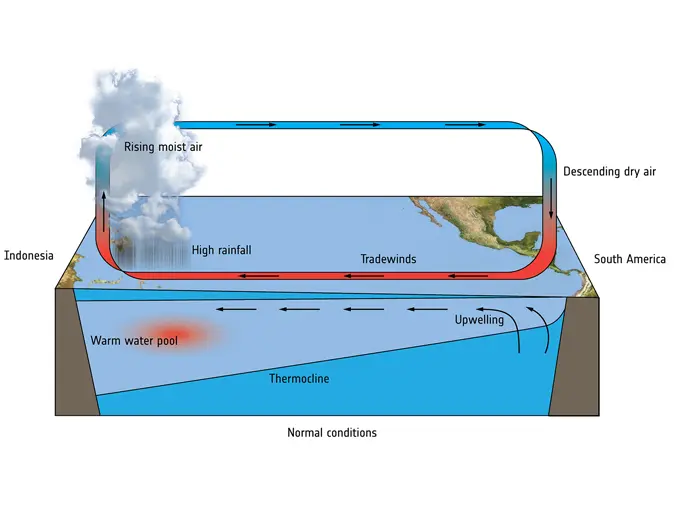
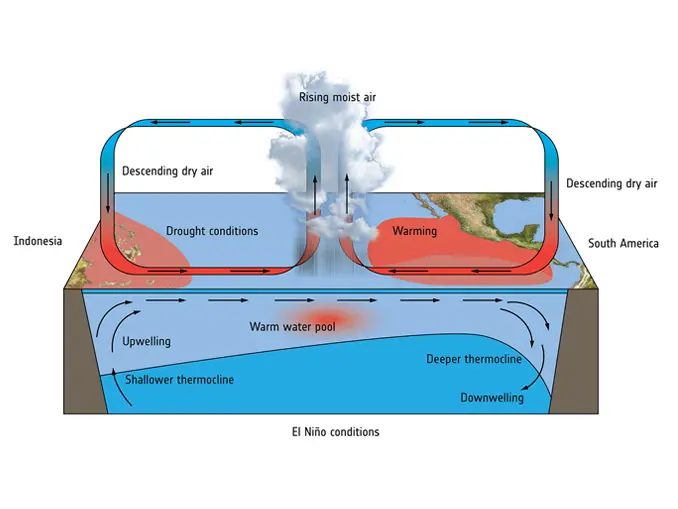
7.El-Nino Effect-
- This is a warm ocean current of appearing along the Peru Coast in December.
- It affects the surface temperature of Southern Pacific Ocean.
- El-Nino is a Spanish Word and is defined as child chariot or child of crime.
- It is developed due to increase in temperature of South Pacific Ocean.
- The presence of this current was known for the first time in 1983.
- The increase in temperature of South Pacific Ocean helps in the deficiency of Monsoon rainfall in India
- It has its flow along western drift of cold Peru Current, and thus give birth to Pacific Equatorial Counter current.
- El Nina current affects the temperature of Indian Ocean. The increase in surface temperature of Indian Ocean Weakens South-west Monsoon
- Every fourth or fifth year, this warm current tries to weak Indian Monsoon.
- These are responsible for long Monsoon gaps, drought conditions in India. Sometimes, their favourable conditions help in heavy monsoon rains.
- These currents also affect the coral’s life and plankton of fishes in the ocean.
Normal condition
El nino
8.La-Nina-
- Following El-Nino, weather patterns typically return to normal.
- Strong trade winds can result in excessive accumulation of cold water in the central and eastern Pacific region, creating La-Nina.
- La-Nina is essentially the opposite of El Nino.
- La-Nina's presence in India supports the development of the Monsoon.
9.Southern Oscillation-
- The southern oscillation is a pattern of meteorological changes which are often observed between Indian and Pacific oceans. Inter-relation at high and low pressure over the pacific and the Indian Ocean is called southern oscillation.
- It explains the linkages between the pacific and Indian oceans.
- These relations were discovered by Sir Gilbort Walker in 1920.
- It is observed that whenever the surface level pressure is high over the Indian Ocean, there will be low pressure over the Pacific Ocean and vice versa.
- The low-pressure conditions in Indian Ocean is observed in winter, indicate the conductive to good monsoon rainfall in India.
- On the other hand, if Indian Ocean has high pressure, whereas Pacific Ocean has the low pressure, such condition will be conductive to weak monsoon rainfall. Such position is defined as El-Nino year.
- Sir Gilbert Walker, due to close association between change in pressure conditions of both the oceans, and the effect of El-Nino current has referred it as ENSO.
10. Upper air circulation-
(a) Westerly Jet stream and its Impact-
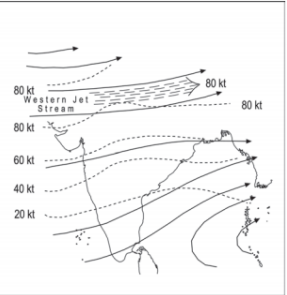
- During winter, a high-speed westerly jet stream blows at around 8 km above sea level over the subtropical zone.
- The Himalayan ranges divide this jet stream into two branches.
- The northern branch flows along the northern edge of the Himalayan barrier.
- The southern branch flows eastwards south of the Himalayas along 25° N latitude.
- Meteorologists believe that the southern branch of the jet stream has a significant impact on winter weather conditions in India.
- This jet stream brings western disturbances from the Mediterranean region into the Indian sub-continent.
- These disturbances cause winter rain and hail storms in northwestern plains and heavy snowfall in hilly regions.
(b) Easterly Jet and its Influence
- In summer, the sun appears to shift in the northern hemisphere and this causes a reversal in upper air circulation.
- The westerly stream is replaced by the easterly jet stream, which is created due to the heating of the Tibetan plateau.
- As a result of this, an easterly cold jet stream develops around 15°N latitude and blows over peninsular India.
- This jet stream helps in the sudden onset of monsoons.
11.Western Disturbances
- The inflow of western disturbances moves under the influence of westerly jet streams from the Mediterranean Sea.
- It influences winter weather conditions over most parts of Northern Plains and Western Himalayan region
- It brings little rain in winter months. This rain is considered to be very good for wheat crops in northern plains.
12.Tropical Cyclones-
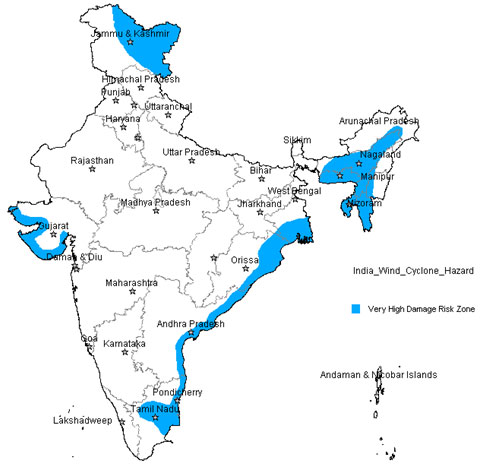
- These originate in Bay of Bengal and Arabian Sea and influence primarily a larger area of south and central India.
- The number of such cyclones is more in Bay of Bengal.
- These cyclones become disastrous on the eastern coast. Their frequency is more during the onset and offset of monsoon seasons
Cyclone Prone Area of India