Water Transport
In India, waterways serve as a crucial mode of transportation for both cargo and passenger traffic. This mode of transport is highly cost-effective and particularly suitable for carrying large and heavy materials. Moreover, it is recognized as a fuel-efficient and environmentally friendly means of transport.
The water transport is of two types–
(a) inland waterways
(b) oceanic waterways
(a) inland waterways
- Inland waterways refer to using inland water bodies like rivers, canals, backwaters, creeks, etc. for transporting goods and other people from one place to another
- India is a land of many long and perennial rivers. But water transport is not very popular in the country. This is mainly due to the seasonal concentration of rainfall, fluctuating river regime, devastating floods during rainy season, shifting river courses etc.
Advantages of Inland water ways-
- Cheapest mode of Transportation
- Reduction in Distance as comparison to other modes of Transportation
- Less environmental pollution as comparison to other modes of transportation
- Suitable for heavy bulky goods
Disadvantages of Inland waterways
- Seasonal variation in water level leads to uncertainty in these water transportation
- Difficulty during the time of monsoon
- Rocky terrain in some of the water ways
- Shifting river course and siltation
- Poor infrastructural and financial development in the field of waterways in India
Some of the Rivers for Inland waterways
Ganga-
- It is navigable by the mechanized boats upto Patna and by ordinary boats upto Haridwar.
- It has been declared as National Waterway No. 1.
- The route has been segmented into three parts for development.
- The three parts are Haldia-Farakka (560km), Farakka-Patna (460 km) and Patna-Allahabad (600 km).
- The National Waterways Act, 1982 has the provision that the regulation and development of the waterway is the responsibility of the Central Government
Brahmaputra
- It is also navigable by streamers upto Dibrugarh for a distance of 1,384 km which is shared by India and Bangladesh.
- Its 891 km long stretch from Sadiya to Dhubri in Assam has been declared as a National Waterway
South India
- Rivers of South India are seasonal and are not much suited for navigation.
- However, the deltaic areas of the Godavari, the Krishna and the Mahanadi, lower reaches of the Narmada and the Tapi,backwaters of Kera Mandovi and Juari rivers of Goa serve as Waterways
Inland Waterways Authority of India (IWAI)
- Inland Waterways Authority of India (IWAI) is the statutory body that regulates Indian National Waterways.
- The authority was established on 27 October 1986 to develop and govern inland waterways for navigation and shipping
- It deals with development, maintenance, management and regulation of National Waterways in the country and to act as advisor to the Central and State Governments on matters relating to inland water transport
- The head office of the IWAI is located at Noida
Central Inland Water Transport Corporation-
- In May 1967, a public sector undertaking called the Central Inland Water Transport Corporation (CIWTC) was established with its headquarters located in Kolkata.
- The primary focus of CIWTC is the transportation of goods through inland waterways, including the Ganga-Bhairathi-Hooghly, Sunderbans, and Brahmaputra rivers.
Important waterways
111 national waterways have been declared under the National Waterways Act, 2016 — 5 pre-existing plus 106 new. Of these, around 29 are operational for shipping and navigation.
1.National Waterways 1 or NW1
- This waterway is declared as National Waterway in 1986.
- NW-1 is passing through UP, Bihar, Jharkhand and West Bengal
- It starts from Allahabad (Prayagraj) to Haldia with a distance of 1620 km.
- The Ganges, Bhagirathi, and Hooghly river system are covered by the NW 1 route, with established terminals in Haldia, Farrakka, and Patna.
- Additionally, floating terminals are present in cities along the riversides, including Kolkata, Bhagalpur, Varanasi, and Allahabad.
- This route is the longest National Waterway in India.
- Farakka's Feeder Canal and navigation lock serve as a connection between the Bhagirathi and the main Ganga upstream of the Farakka Barrage.
Jal Marg Vikas Project (JMVP)
- The JMVP is a project designed to increase the navigation capacity of National Waterway-1 (NW-1).
- Its main objective is to enable the transportation of 1500-2000 ton vessels from Haldia to Varanasi for commercial purposes.
- The project's scope includes the maintenance and expansion of key infrastructure such as inter-modal and multimodal terminals, Roll-on-roll (Ro-Ro) facilities, navigation aids, and ferry services.
2.National Waterways 2
- The National Waterways 2 refers to a section of the Brahmaputra River that runs from Sadiya to Dhubri in the state of Assam.
- This stretch of the river was officially designated as a National Waterway in the year 1988.
- NW 2 is an important mode of transportation for cargo in northeast India, and it is the third-longest waterway in the country, spanning a total distance of 891 kilometers.
3.National waterways 3
- It was formed in 1992(and notified in 1993)
- Kollam-Kottapuram stretch of West Coast Canal and Champakara and Udyogmandal Canals is declared as National waterways 3
- The 205 km long West Coast Canal is India’s first waterway with all-time navigation facility
- It is located in Kerala
- The Champakara and Udyogmandal canals link industrial centers of Ambalamugal and Udyogmandal with the Kochi port
4.National Waterway 4
- It includes Specified stretches of Godavari and Krishna rivers along with Kakinada Puducherry stretch of canals (1078 km)
- It is 2nd Longest waterway of India
- The Buckingham Canal that runs through Tamil Nadu and Andhra Pradesh is an inland waterway that has fallen into disuse in recent times.
- It was declared as waterway in 2008
5.National Waterway 5
- NW-5 refers to the waterway formed by the East Coast Canal and the Brahmani and Mahanadi delta river system.
- NW-5 links the states of Orissa and West Bengal through the use of the Brahmani River, East Coast Canal, Matai River, and Mahanadi River Delta.
- The stretch of the East Coast Canal, Brahmani River, and Mahanadi River Delta make up NW-5.
- NW-5 encompasses the waterways that run through the Brahmani and Mahanadi delta river system, connecting Orissa and West Bengal.
- To travel between Orissa and West Bengal via water, one can use NW-5, which is composed of the East Coast Canal, Brahmani River, Matai River, and Mahanadi River Delta.
Sittwe port
India Bangladesh protocol
Ocean Transport-
- Oceanic routes have a significant impact on India's transportation sector. According to estimates, around 95% of India's foreign trade is transported by volume and 70% by value through sea routes. India boasts a coastline of approximately 7,517 kilometers.
- India has 7,516.6 km long coastline (including 1,962 km of Andaman and Nicobar Islands and 132 km of Lakshadweep Islands) which brings importance of coastal transportation to
Ports of India
- Ports of India are divided into Two major groups i.e., Major ports and Minor ports
- The major ports are under the jurisdiction of the Central Government, while the minor and intermediate ports are managed and maintained by the respective State Governments.
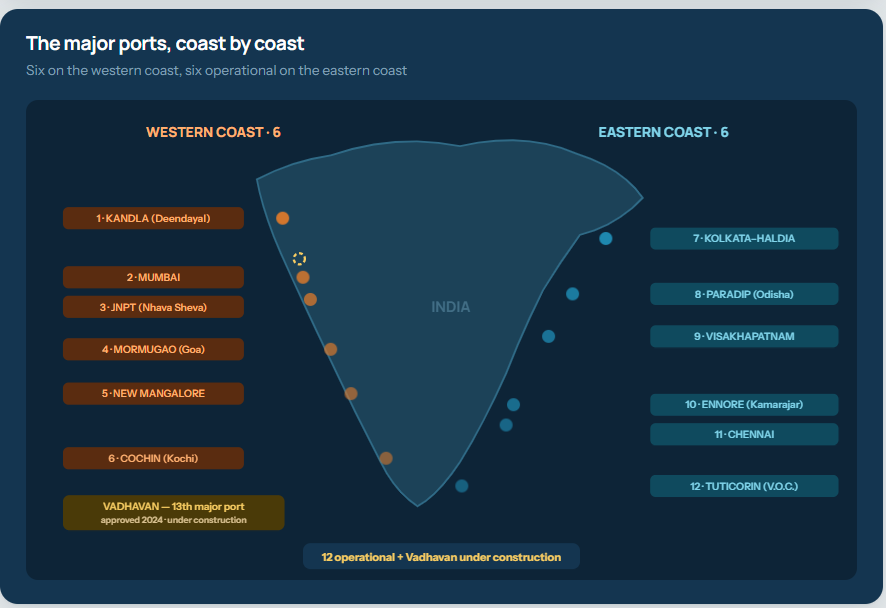
- On the count of major ports: 12 are currently operational — 6 on each coast. Vadhavan in Maharashtra was approved on 19 June 2024 as the 13th, but is still under construction, which is why some sources say 12 and others 13. Port Blair lost its major-port status in 2017.
- There are more than 2000 non major ports in India
Major ports of India
1.Kandla-
- It is Located at the head of Gulf of Kutch
- Kandla sea-port was developed after Independence to take up the place of Karachi which went to Pakistan.
- It is a tidal harbor in the Kandla Creek with an average depth of 10 metres.
- Its main imports are fertilizers, phosphates, sulphurs and petroleum, while the export includes bones, cotton, food-grains, naptha, salt and sug
2. Jawahar Lal Nehru (Nhova Shiva) Port
- It is located on the eastern shore of Mumbai harbour off Elephanta Island and is accessed via Thane Creek.
- It is a world class port equipped with all the modern facilities
- This sea-port was developed to ease the pressure on the Mumbai sea-port.
- The sea-port is connected by a four-lane highway with the hinterland.
- It is India’s largest container port.
3. Ennore
- It Situated north of Chennai
- Ennore is a natural harbor.
- It was developed to ease the pressure of the Chennai-seaport.
- The port has been renamed as Kamarajar Port Limited and holds the distinction of being the first corporate port in India. It is a publicly registered company, with the government holding a 68% stake in the company.
4. Chennai
- It is Situated along the northern coast of Tamil Nadu
- It is an artificial sea port.
- Chennai Port is the largest port in the Bay of Bengal and the second largest port of India after JNPT. It is the largest port at the east coast.
5. Cochin Portin Kochi
- It Situated along the coast of Kerala, Kochi is a natural sea-port and the largest shipyard in the country.
- The indigenous Aircraft Carrier for the Indian Navy is also present in the shipyard.
- It remains open for cargo traffic throughout the year.
- Being situated close to the Suez-Colombo route, it has great commercial and strategic importance.
- Located on the Willington Island on the South – West coast of India
- The port is widely recognized as the primary entrance to the extensive industrial and agricultural markets of South-West India.
6. Kolkata-Haldia-
- The Kolkata-Haldia port is situated along the Hugli River.
- The port has a large hinterland which covers the seven states of Bihar, Chhattisgarh, Jharkhand, north-east India, Odisha and eastern Uttar Pradesh.
- Only riverine major port in India.
- Known for twin dock systems viz, Kolkata Dock System (KDS) on the eastern bank and Haldia Dock Complex (HDC) on the western bank of river Hooghly.
7. Mormugao-
- Situated at the entrance of the Zuvari estuary in Goa it is the leading iron-ore exporting sea-port of the country.
8. Mumbai-
- It is the largest and the most important sea-port along the western coast of India.
- It was developed by the British in 1672 as a substitute to the Surat seaport.
- It has a natural harbor about 12 m deep.
- It is one of the oldest modern ports of India. Initially, the location was used by the navies of Shivaji.
9. New Mangalore-
- Situated along the coast of Karnataka Located at a side called Panambur in Karnataka at Gurupura river confluence with the Arabian Sea.
10. New Tuticorin/ V.O. Chidambaranar Port-
- The V.O. Chidambaranar Port, previously known as the Tuticorin Port, is situated in the Gulf of Mannar.
- The port has been renamed in honor of V.O. Chidambaranar.
- The port offers a direct weekly container service to the United States, which is unique in South India.
- The port has an artificial deep-sea harbor.
11. Paradwip
- Situated along the coast of Odisha, it is a deep-water artificial seaport
- Paradwip has the deepest harbor in the country petroleum products.
- It was the first major port on East Coast commissioned in independent India.
12. Vishakhapatnam Port
- The port of Vizag, situated in the state of Andhra Pradesh, is recognized for its significant role in handling a large volume of cargo on the eastern coast of India.
13. Vadhavan Port
- The Vadhavan Port is set to become India's 13th major port.
- Upon its completion, the port's development will enable India to be included among the top 10 container ports globally.
- To implement the project, an SPV will be formed, with the Jawaharlal Nehru Port Trust (JNPT) as the primary partner, holding 50% or more equity participation.
- The port will be built on the landlord model, which means the government will own the land and lease it to private entities for construction and operation.
- The JNPT has planned the Vadhavan Port to function as an all-weather, all-cargo satellite port that can handle deep draft ships and larger vessels.
Issues related to Shipping and ports in India-
- Ports not equipped to handle large containers
- High turnaround times for ships
- Wide gap between carrying capacity and multi-folded cargo growth in the country
- Less Mechanization of Indian ports as comparison to other developed countries
Sagarmala Project
- Sagarmala aims are port-led industrialization, development of world-class logistics institutions, and coastal community development.
- It was approved by the Union Cabinet in 2015
- The vision of the Sagarmala Programme is to reduce logistics costs for EXIM (Export-Import) and domestic trade with minimal infrastructure investment.
Components of the Sagarmala Programme
- Port Modernization & New Port Development
- Port Connectivity Enhancement
- Port-linked Industrialization
- Coastal Community Development
- Coastal Shipping & Inland Waterways Transport
- A National Sagarmala Apex Committee (NSAC) is envisaged for overall policy guidance and high-level coordination, and to review planning and implementation under the chairmanship of the Minister of Shipping.
- A new committee called the Sagarmala Coordination and Steering Committee (SCSC) will be established to facilitate coordination among the relevant ministries, state governments, and related agencies. The committee will be chaired by the Cabinet Secretary and include the Secretaries of the stakeholder Ministries as members. This committee will work to ensure effective collaboration and cooperation between all involved parties.
Recycling of Ships Act, 2019
- The Recycling of Ships Act, which was passed in 2019, establishes regulations for the recycling of ships by defining specific global standards and creating a legal framework for implementing and enforcing them.
- It was enacted for the regulation of ship recycling and accession to the Hong Kong International Convention for Safe and Environmentally Sound Recycling of Ships, 2009.
Hong Kong Convention For Recycling of Ships Act 2019
- The aim of the Hong Kong Convention is to tackle various aspects related to ship recycling.
- One of the focal points of the convention is to tackle the issues related to working and environmental conditions at ship recycling sites.
- The International Maritime Organization is responsible for enforcing and monitoring the implementation of the convention.
- The Hong Kong Convention has provisions that cover the safe and environmentally friendly recycling of ships, which includes aspects such as design, construction, operation, and maintenance.
Air Transportation
- Air travel is currently the most rapid way to travel between locations, with travel time being significantly reduced.
- The Ministry of Civil Aviation is in charge of establishing national policies and plans for civil aviation development and control, as well as creating and executing strategies for orderly growth and expansion.
- Air India is responsible for managing air transportation in India.
- Pawan Hans Helicopter Ltd., a public sector organization, provides helicopter services to ONGC for offshore operations and is also employed by several state governments.
History of Indian Airlines
- The inception of air transport in India dates back to 1911, with the commencement of airmail operations covering a distance of 10 km between Allahabad and Naini.
- In 1933, Indian National Airways was established, which initiated air services between Karachi and Lahore.
- By 1947, four major companies namely Indian National Airways, Tata Sons Limited, Air Services of India, and Deccan Airways were providing air transport services in India.
Airport Authority of India
- The Airport Authority of India is responsible for providing safe, efficient air traffic and aeronautical communication services in the Indian Air Space
- The Airport Authority of India (AAI), constituted on 1st April 1995, operates airports including civil enclave and defence airfields for Commercial Airlines Operations.
Open Sky Policy
- In April 1992, the government implemented an "Open Sky Policy" for cargo.
- This policy allows foreign airlines or groups of exporters to bring an unlimited number of freighters into the country for the transportation of cargo.
FDI-
- 100% FDI has been allowed under automatic route for both Greenfield as well as brownfield projects
Integrated National Civil Aviation Policy 2016
- The Integrated National Civil Aviation Policy 2016 aims to offer secure, affordable, and sustainable air travel for passengers and cargo transportation.
- The policy envisions an ecosystem to make flying accessible and affordable for everyone, providing access to different parts of India and the world.
- By 2022, the policy intends to enable 30 crore domestic ticketing and increase it to 50 crore by 2027.
- Additionally, the policy aims to increase international ticketing to 20 crore by 2027.
UDAN Scheme (Ude Desh Ka Aam Naagrik )
- The UDAN Scheme is a key component of the National Civil Aviation Policy
- It was launched as a Regional Connectivity Scheme (RCS) under the Ministry of Civil Aviation in 2016.
Features:
- The UDAN Scheme, also known as Ude Desh Ka Aam Naagrik, aims to enhance connectivity by providing air travel to underserved and un-served airports in India.
- The scheme seeks to achieve its objective by revitalizing existing air-strips and airports.
- The UDAN Scheme is operational for ten years.
- As per the scheme, almost 50% of the seats in Udan flights are offered at subsidized rates.
- To encourage airlines to participate, the central and state governments jointly fund the scheme.
- Participating carriers are provided viability gap funding (VGF), which is a certain amount shared between the Centre and the concerned states.
- A minimum of 50% of an aircraft's total seats must be available at a lower cost.
- The remaining 50% of seating capacity is charged at market rate.
Targets:
- The Ministry of Civil Aviation plans and commits to construct 100 new airports by 2024 in India with 1,000 new routes
Krishi Udaan
- On October 27th, 2021, Krishi UDAN 2.0 was launched with the aim of enhancing value realization by improving the integration and optimization of Agri-harvesting and air transportation.
- This initiative strives to bolster Agri-value chain sustainability and resilience in various and changing circumstances.
- Krishi Udan Scheme is a convergence scheme that involves eight Ministries/Departments.
National Air Sports Policy (NASP 2022)
- The National Air Sport Policy 2022 (NASP 2022) has been introduced with the objective of transforming India into one of the leading sports nations globally by 2030. The policy focuses on establishing a secure, reasonably priced, readily available, enjoyable, and sustainable air sports infrastructure across India.
The policy will cover the following air sports in India: -
- Aerobatics ,Aero modeling and model rocketry,Amateur-built and experimental aircraft,Ballooning,Drones,Gliding etc.
Drone rules 2021-
- Overview: The Ministry of Civil Aviation has introduced the Draft Drone Rules 2021, which are based on "trust, self-certification, and non-intrusive monitoring" to facilitate the growth of the drone industry in India.
Abolishment of Approvals: The new rules eliminate the need for various approvals such as operator permit, student remote pilot license, authorisation of R&D organization, acceptance of existing drones, certificate of maintenance, and certificate of conformance.
Digital Sky Platform: The government is developing a digital sky platform that will feature an interactive airspace map, dividing the country into green, yellow, and red zones.
Airport Perimeter: The draft rules reduce the airport perimeter from 45 km to 12 km. No flight permissions are required to fly up to 400 feet in green zones and up to 200 feet in the area between 8 and 12 km from the airport perimeter.
Pilot License: Micro drones used for non-commercial purposes and nano drones will not require a pilot license. Additionally, R&D organizations will also be exempt from obtaining a pilot license.
Foreign Ownership: The new rules allow for no restrictions on foreign ownership in Indian drone companies.
Drone Corridors and Promotion Council: The Ministry will facilitate the development of drone corridors for cargo deliveries, and a drone promotion council will be established to promote a business-friendly regulatory environment.
Safety Features: The draft rule mandates the implementation of safety features such as real-time tracking beacon, and geo-fencing to ensure the safety of the public and the drone operators.
Challenges faced by Aviation sectors
- Decline in Quality of Service
- Shortage of trained employee
- Rising fuel prices
- Lack of Proper Infrastructure
- High Aircraft-Man Ratio
Communication Network
1. Radio
- In 1923, the Radio Club of Bombay initiated radio broadcasting in India.
- In 1930, the Indian government took over this widespread communication medium through the Indian Broadcasting System.
- The Indian Broadcasting System was later renamed All India Radio in 1936 and Akashwani in 1957.
2. Television (T.V.)
- In 1959, television services were introduced in the National Capital, with limited availability.
- From 1972, additional centers began offering television services.
- In 1976, television was separated from All India Radio and given a distinct identity as Doordarshan (DD).
- The launch of INSAT-IA in later years marked a significant development in the expansion of Doordarshan services.
3. Postal Services
- The provision of postal services is essential for the development of rural areas, and nearly all villages in the country (99%) have access to these services today.
- India Post serves as the main postal system for India.
- India Post was established on April 1, 1854.
- The organization operates under the Ministry of Communication, which is part of the Government of India.
- In July 1852, Bartle Frere issued the first stamps in Asia from India.
PIN (Postal Index Number) -
- It has facilitated the prompt delivery of mail
- Postal Index Number is a 6-digit code of post office introduced on 15th August 1972.
Speed post service
- Speed post service has been introduced for fast and quick delivery of post
- Quick Mail Service (QMS) is another step in this direction.
4.Satellite Communication
- Satellites are mode of communication in themselves as well as they regulate the use of other means of communication
- 1st satellite of India was Aryabhata launched in 1975
On the basis of configuration and purposes, satellite system in India can be grouped into two-
A. Indian National Satellite System (INSAT)
B. Indian Remote Sensing Satellite System (IRS).
1.The INSAT
The INSAT, which was established in 1983, is a versatile satellite system designed for a range of applications including telecommunications, meteorological observations, and various other data and programs.
2.The IRS satellite
The IRS satellite system began functioning when the first satellite, IRS-IA, was launched in March 1988 from the Vaikanour spaceport in Russia.
India has also developed her own Launching Vehicle PSLV (Polar Satellite Launch Vehicle), GSLV, ASLV
Other-
1. Telegraph-
- In 1850, an experimental electric telegraph line was initiated between Diamond Harbour and Calcutta.
- The British East India Company was given access to use the telegraph line in 1851.
- The Indian Telegraph Act was introduced in India in 1885 to regulate telegraph communication.
2. Oil and Gas Pipeline
- Transporting liquids and gases over long distances is most efficiently achieved through the use of pipelines. This method is highly convenient and reliable. Additionally, even solid materials can be transported through pipelines if they are first converted into a slurry.
Oil India Limited (OIL)
- OIL operates under the Ministry of Petroleum and Natural Gas and is involved in the exploration, production, and transportation of crude oil and natural gas.
- The company was established in 1959.
- OIL constructed Asia's inaugural cross-country pipeline spanning 1,157 km from the Naharkatiya oilfield in Assam to the Barauni refinery in Bihar.
GAIL (India) Ltd.
- It was set up in 1984 as a public sector undertaking to transport, process and market natural gas for its economic use.
Hazira-Vijaipur - Jagdishpur (HVJ)
- It is India's first cross state gas pipeline
- The first 1,700 km long Hazira-Vijaipur - Jagdishpur (HVJ) cross country gas pipeline, constructed by GAIL (India), linked Mumbai High and Bassein gas fields with various fertiliser, power and industrial complexes in western and northern India.
- This artery provided impetus to Indian gas market development