Pollution refers to any undesirable change in the physical, chemical or biological characteristics of our environment , i.e. , air, water and Humans and Ecology soil that may or will adversely affect humans or other species and life support systems of our biosphere directly or indirectly.
Classification of Pollutants
1. On the basis of natural disposal, pollutants are of two types:
Non-degradable pollutants-
- Non-degradable pollutants refer to pollutants that degrade at a very slow pace by natural biological processes.
- These pollutants include inorganic compounds such as chlorides and metallic oxides, as well as waste-producing materials like aluminum cans, mercuric salts, and even DDT.
Biodegradable pollutants-
- Biodegradable pollutants refer to pollutants that can be broken down by natural processes or artificial methods. Domestic sewage is an example of a biodegradable pollutant as it can easily decompose under natural conditions and can be rapidly degraded through various artificial methods.
2. On the basis of the form in which they persist
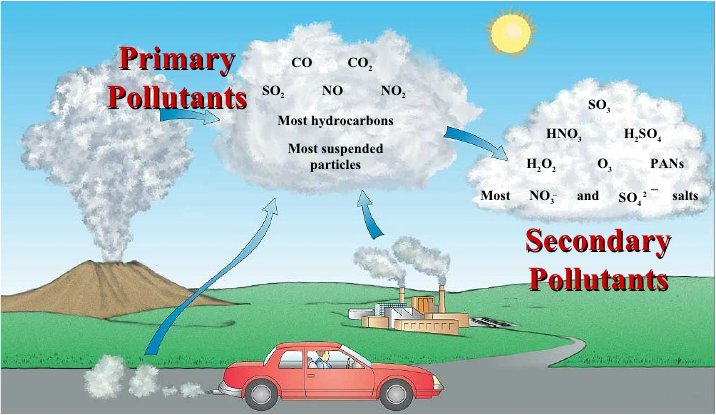
Primary pollutants
These include those substances, which are emitted directly from some identifiable sources. This includes-
(a) Sulphur compounds-
- SO2, H2S produced by the oxidation of fuel.
(b) Carbon compounds-
- Oxides of carbon (CO+CO2) and hydrocarbons.
(c) Nitrogen compounds-
- NO2 and NH3.
(d) Halogen compounds-
- Hydrogen fluoride (HF) and hydrochloric acid (HCl).
(e) Particles of different size and substances-
- Airborne particles of various sizes and substances are commonly found in the environment. Fine particles with diameters less than 100 u are more prevalent and include a variety of substances such as metals, carbon, tar, pollen, fungi, bacteria, silicates, and more.
Secondary pollutants
- Secondary pollutants are generated through the chemical reaction and combination of primary pollutants emitted into the atmosphere.
Example-
- Ozone, Smog, formaldehyde and PeroxyAcyl Nitrate (PAN)( formed by the interaction of nitrogen oxides and hydrocarbons.),SO3,
Is nitrogen dioxide a primary or secondary pollutant?
Though nitrogen dioxide can be a primary pollutant, it’s mostly a concern as a secondary pollutant. As a primary pollutant, NO2 is emitted in limited amounts through vehicles into the air.
Nitrogen dioxide is also a secondary pollutant because it can be formed through oxidization. Nitrogen dioxide further oxidizes into nitric acid (HNO3), which can enter the environment through the ground as droplets or nitrate-containing particles.
Important Short Question and answers on Introduction to Pollution.
What are non-degradable pollutants?
Non-degradable pollutants are pollutants that degrade at a very slow pace by natural biological processes.
What are biodegradable pollutants?
Biodegradable pollutants are pollutants that can be broken down by natural processes or artificial methods.
What are primary pollutants?
Primary pollutants are those substances emitted directly from some identifiable sources, such as sulfur compounds, carbon compounds, nitrogen compounds, halogen compounds, and particles of different sizes and substances.
What are secondary pollutants?
Secondary pollutants are generated through the chemical reaction and combination of primary pollutants emitted into the atmosphere, such as ozone, smog, formaldehyde, and PAN.
What are some examples of non-degradable pollutants?
Examples of non-degradable pollutants include inorganic compounds such as chlorides and metallic oxides, waste-producing materials like aluminum cans, mercuric salts, and DDT.