Water pollution refers to the presence of substances in water sources that render it unsuitable for various purposes, such as drinking, cooking, cleaning, swimming, and other activities.
Water Pollutants
Water pollution can occur on account of any one or more of the following agents-
1.Biological -
- Pathogens such as virus, bacteria, protozoa and worms.
2.Chemical –
a) Inorganic:
- Nitrates, phosphates, chloride and fluoride.
b) Organic:
- Pesticides, dyes, chloro-compounds, phenols, points and plastics.
c) Heavy metals:
- Soluble heavy metal ions such as mercury, lead, cadmium, copper, zinc and their organometallic compounds.
3. Physical-
- The quality of water can be affected by physical factors such as temperature, suspended solids, and sedimentary solids, which are often the result of waste heat from industrial plants.
Sources of Water Pollution
Point sources
- They are distinct and confined sources that discharge the pollutants / effluents through a chimney or through a discharge channel such as pipes or tunnels from industries or municipal areas.
- These include direct discharges from factories, energy plants, effluent treatment plants, etc.
- In the case of point sources of pollutants, the location is easy to find and therefore, easy to control.
Non-point sources or area sources
- These are diffused sources that discharge pollutants over a large area.
- The non- point sources are less discrete and mainly includes agricultural runoff, storm water runoff, which includes oils, atmospheric precipitation etc.
- Due to the way they spread, these are difficult to control.
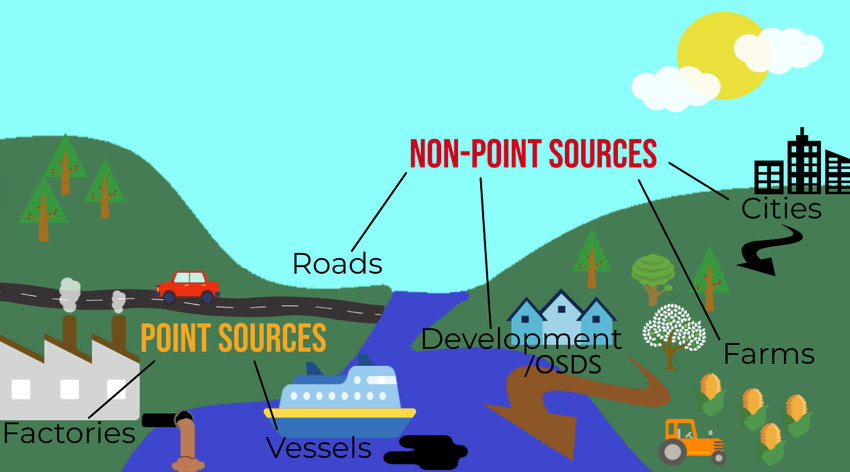
Sources of surface water pollution-
1.Domestic sewage
- Domestic sewage refers to the waste generated from households, including food waste, synthetic detergents used for washing clothes, cleaning bathrooms and latrines, and water-based paints.
The Hooghly estuary is significantly polluted with domestic and municipal waste, as well as effluents from a multitude of industries located along its shore.
2.Industrial Effluents
- Industrial effluents are known to contain heavy metals like mercury, cadmium, lead, copper, and arsenic.
- Mercury compounds are often used in agriculture to prevent plant diseases, but they can be washed away by rainwater and contribute to water pollution.
- The textiles, sugar and fertilizers factories, oil refineries, drugs manufacture, rubber, and rayon fibers, the paper industries and the chemical factories all produce Chemical pollution.
3.Agricultural source
- Pollutants from inorganic fertilizers, pesticides, insecticides, and rich manure applied on cultivated lands, as well as solid waste disposal from urban and industrial areas, are carried by surface run-off and cause significant contamination of natural water bodies.
- Pesticides such as DDT (Dichloro-diphenyl tetrachloro-ethene) 2,4D (Dichlorophenoxy acetic acid), dieldrin, malathisn, carbaryl are used for crop protection but they have bad impact on our water resources.
4.Thermal pollution
- Power plants and nuclear power stations are the main sources of thermal pollution of water where water is used for cooling and becomes hot.
- Aquatic plants and animals are negatively impacted by the increase in water temperature caused by the introduction of hot water into their environment. This rise in temperature can result in the death of fish and other aquatic creatures, as well as an increase in the rate of respiration for plants.
5.Pathogenic organisms
- Pathogenic organisms such as protozoa, worm eggs, and bacteria can be introduced into water through sewage and domestic waste from houses.
- Consuming contaminated water can lead to various illnesses including jaundice, typhoid, dysentery, cholera, and tuberculosis.
Sources of Ground water pollution-
1.Industrial -
- Leaks from waste disposal sites like chemicals, radioactive material etc.
2.Agricultural-
- Seepage from agricultural activities (nitrates, heavy metals, pesticides, herbicide etc.)
3.Urban & Rural areas-
- Seepage from septic systems, Seepage of pesticides, herbicides, nutrients etc.
4.Oil spills-
- Seepage from accidental spills
5.Others-
- Seepage of solvents, detergents and other chemicals, radioactive material from big industrial and small-scale industrial sites, Salt water infusion into coastal aquifers etc.
Sources of Marine water pollution-
1.Sewage sludge-
- The rivers that drain in the sea contain bacteria and virus laden organic matter, toxic metals, synthetic chemicals, and solid remains from waste water at sewage treatment plants.
2.Industrial effluents –
- Contain hazardous chemicals, plastics, tins, metals, scrapping, fertilizers and pesticides.
3.Waste heat-
- Hot water released from industries is also dumped into the ocean.
4.Oil spills and discharge from marine vessels –
- These are due to oil tanker accidents offshore oil drilling, mini spills, natural leakage etc.
- Oil spills are a major source of pollution of sea water.
- About half of the oil in the sea comes from natural seepage from offshore deposits. One-fifth comes from well blowouts, leaking pipelines and tanker spills
Effects of Oil spill-
- In the aquatic environment, oil can have both physical and biological impacts. These impacts include reducing light transmission, decreasing the amount of dissolved oxygen in the water, harming water birds, and suffocating intertidal organisms.
- The toxic effects are exhibited mostly by the light portion (low boiling) of the oil, i.e. , polyaromatic hydrocarbon (PAH). The effects include cell damages and death of sensitive organisms and larval stages.
5.Toxic wastes in sealed containers –
- These are packed with wastes containing poisonous chemicals, radioactive isotopes.
Water Quality Parameters
Water samples are tested for various parameters to ensure that water is fit for consumption. Some of these parameters are as follows-
1.Dissolved Oxygen (DO)
- It refers to the amount of oxygen gas (O2) that is dissolved into the water of any water source.
- Higher amounts of dissolved oxygen indicate that water quality is good.
- Low concentrations of oxygen content in the water indicate the presence of organic waste pollutant in water
2. Biological Oxygen Demand (BOD)
- BOD is a measure of oxygen used by microorganisms such as bacteria to decompose the organic matter like sewage, dead plant leaves, grass blades and food wastes.
- If the number of organic wastes is high in the water source, more bacteria will be present to consume oxygen.
- Under such polluted conditions demand for oxygen will be high and so the BOD values will be high.
- With high levels of BOD, levels of DO in the water decrease.
3.Chemical oxygen demand
-
The measurement of chemical oxygen demand refers to the quantity of oxygen required for the oxidation of organic substances present in water.
- A water body that receives effluents from chemical industries shows high values of COD.
4.Most Probable Number (MPN)
- MPN method statistically predicts the number of these organisms present in the water body.
- The water polluted with organic wastes such as sewage/sludge will have high population of bacteria like E.coli and coliforms.
- With the help of MPN test both E.coli and coliforms can be detected and enumerated.
- Coliform is present in human intestines and is not necessarily harmful to us. But its presence indicates the presence of human waste in the water.
5.Total Dissolved Solids (TDS)
- The number of salts and solids dissolved in water is measured by testing the TDS and salinity contents.
- Some of the dissolved substances that make the water quality poor are calcium, phosphorus, iron sulphates, carbonates, nitrates, chlorides, and other salts.
- Heavy metals also fall in this category.
6.Hardness
- Hardness refers to the properties of water with high mineral content.
- When water contains a high level of dissolved minerals, it can create issues such as scale deposits in hot water pipes and soap that does not lather well.
- These mineral deposits can also cause problems for household appliances, such as dishwashers and washing machines.
- The hardness of water is typically measured in terms of grains per gallon or parts per million.
- Calcium (Ca2+) and magnesium (Mg2+) ions cause the greatest portion of hardness in naturally occurring waters.
- These ions are present as bicarbonates, sulfates, and sometimes as chlorides and nitrates .
Types of Hardness-
Temporary hardness -
- Which is due to carbonates and bicarbonates can be removed by boiling
Permanent hardness -
- Which remains after boiling is caused mainly by sulfates and chlorides
7.Turbidity
- Turbidity refers to the cloudiness or haziness of water, which reduces the ability of light to pass through it.
- The measurement of turbidity is an indicator of the amount of suspended particles present in water, such as organic material, clay, silt, plankton, and other particulate matter.
- The suspended particles in water are responsible for the scattering and absorption of light, which causes the water to appear murky or cloudy.
- Turbidity is usually measured in Nephelometric Turbidity Units (NTUs) using a turbidimeter, which determines the amount of scattered light by suspended particles in water.
- High turbidity levels in water can negatively impact aquatic life by reducing light penetration and oxygen availability for aquatic plants and animals.
- Turbidity is an important parameter used in water quality monitoring and treatment processes, as high turbidity levels can also indicate the presence of pathogens and other harmful contaminants in water.
8.pH
- Water quality is determined by various parameters, among which pH is crucial.
- The pH of a solution is determined by taking the negative logarithm of the hydrogen ion concentration.
- The pH scale is used to indicate the acidity or basicity of a solution and is a dimensionless number.
- Aquatic flora and fauna have adapted to a particular pH range, and even minor changes in pH levels can harm them.
9.Acidity
- Acidity is the measure of acids in a solution.
- The acidity of water is its quantitative capacity to neutralize a strong base to a selected pH level.
- Acidity in water is usually due to carbon dioxide, mineral acids, and hydrolysed salts such as ferric and aluminium sulfates
- Carbon dioxide from the atmosphere or from the respiration of aquatic organisms causes acidity when dissolved in water by forming carbonic acid (H2CO3)
10.Alkalinity
- The alkalinity of water is determined by the total amount of titratable bases it contains.
- Water's alkalinity primarily results from the presence of hydroxide ions (OH−), bicarbonate ions (HCO3−), carbonate ions (CO32−), or a combination of two of these ions.
- Elevated levels of either acidity or alkalinity in water may indicate the presence of industrial or chemical pollutants.
11.Some chemicals
Chloride-
- Chloride occurs naturally in groundwater, streams, and lakes. Chlorides are not usually harmful to people; however, the sodium part of table salt has been connected to kidney and heart diseases.
Fluoride-
- A moderate amount of fluoride ions (F−) in drinking water contributes to good dental health. About 1.0 mg/L is effective in preventing tooth decay, particularly in children.
- Excessive amounts of fluoride cause discoloured teeth, a condition known as dental fluorosis
- The presence of F– ions in teeth enamel leads to increased hardness by converting hydroxyapatite.
- If the concentration of F– ions exceeds 2 parts per million (ppm), it can cause brown mottling of teeth.
- However, when there is an excess of fluoride (over 10 ppm), it can have harmful effects on teeth and bones, as has been reported in certain regions of Rajasthan.
Lead-
- When water is transported through pipes made of lead, it can become contaminated with lead.
- Consuming lead-contaminated water can lead to serious health problems such as damage to the kidneys, liver, and reproductive system.
- The use of lead pipes for water transportation has been largely phased out due to health concerns.
Nitrate-
- The highest acceptable limit of nitrate in drinking water is 50 parts per million (ppm).
- Presence of excessive nitrate in drinking water can lead to the development of certain diseases, including methemoglobinemia, which is also known as 'blue baby' syndrome.
Toxic Metallic compounds-
- There is a group of toxic metallic compounds that includes several heavy metals.
- These metals are cadmium (Cd), chromium (Cr), lead (Pb), mercury (Hg), silver (Ag), arsenic (As), barium (Ba), thallium (Tl), and selenium (Se).
- Each metal has a different range of harmful effects, which can vary significantly from one to another.
Effects of Water Pollution
- Chemically harmful compounds such as mercury, arsenic, and lead have poisonous properties that can negatively impact water treatment facilities.
- Example- organic sulphur compounds interfere with nitrification.
- Aquatic plants can absorb mercury when it's dissolved in water, allowing it to enter the food chain.
- Exposure to lead can impair metabolism and cause congenital deformities, anemia, and other health problems.
- Cadmium is known to cause damage to the kidneys and liver.
- Inorganic nitrates and phosphates can contribute to the growth of algae that consume oxygen, ultimately leading to the death of fish and other aquatic animals.
- Soap, detergents, and alkalis can create foam formation in water bodies.
- Industrial effluents containing iron, free chlorine, phenol, manganese, oils, hydrocarbons, ammonia , algae and microorganisms impair the taste and odours of water.
- When water contains nitrates and phosphates, it can lead to the acceleration of microorganism growth. As a result, these microorganisms consume a large portion of the dissolved oxygen in the water, which can deprive aquatic life, such as fish, of the oxygen they need to survive. This process is known as eutrophication.
Some of the Major Consequences of Water Pollution
1.Bioaccumulation/Bioconcentration
- Certain chemicals can accumulate within the bodies and the phenomenon is referred to as bioconcentration
For example-
- DDT, an organochloride, does not dissolve in water but dissolves in fats, therefore, it accumulates in the organism for a long period.
- DDT and its metabolites cause thinning of bird's eggshells.
- These poisons then move in other organisms through food chain.
- These chemicals are -Fat soluble, Water insoluble& have Longer life etc.
2.Bio magnification
- The increase in concentration of a toxin in food chain at higher level is called biomagnification.
3.Minamata disease
- Mercury compounds discharged in effluents are converted into highly toxic methyl mercury by bacterial action in the aquatic environment.
- In 1952 poisoning in Japan resulted in "Minamata disease" due to eating of fish taken from mercury polluted Minamata Bay.
- The victims developed numbness of the limbs, lips and tongue and lost control.
- It also caused deafness, blurring of vision; apathy and mental derangement.
4.Itai-Itai
- It is caused due to Cadmium.
- Cadmium pollution caused another disease called Itai-Itai which again occurred in Japan due to the consumption of rice affected with cadmium metal.
- The rice fields were irrigated with effluents released by zinc smelters.
- Itai-Itai is a painful disease of bone and results in the cancer of liver and lungs.
- Cadmium gets accumulated in liver, kidneys and pancreas and interferes with some enzymes.
5.Blue baby syndrome-
- It is caused by excess Nitrates.
- Excess of nitrate in drinking water ) causes methemoglobinemia.
- Nitrate converts haemoglobin to methaemoglobin-oxidised form of haemoglobin which is non-functional.
- Nitrate can be fatal to human, especially infants under three months. 1 Such infants are called "blue babies"
6.knock knees or Skeletal fluorosis
- It is caused due to excess of fluoride content in drinking water.
Eutrophication
- The growth of nuisance algae and higher aquatic plants in natural waters is caused by eutrophication, a process that can be of both natural and anthropogenic origin. This process leads to an increase in the supply of plant nutrients to water bodies.
Eutrophic water bodies are characterized by a number of different conditions. These include:
- Decreasing dissolved oxygen concentrations in deeper waters.
- Increasing nutrient concentrations in the water.
- Increasing organic suspended solids.
- Decreasing light penetration.
- Increasing phosphorus concentrations in the sediments.
- Progression from an algal population that is predominately diatom-based to one that is predominately cyanobacteria.
Types of Eutrophication
1.Artificial Eutrophication
- Artificial Eutrophication is basically a process that occurs when human release excessive amounts of nutrients into the water bodies.
2.Natural Eutrophication-
- Eutrophication that occurs naturally as a result of the aging process of a body of water over several centuries or millennia is known as natural eutrophication. It is a phenomenon that occurs without human interference.
Sources of Eutrophication
Point sources
In point sources, the nutrient wastes travel directly from source to water and these includes-
- Industrial effluents.
- Irrigation drains.
- Sewage treatment plant discharges.
Non- Point Sources-
In Non-Point sources, wastes come from ill- defined and diffuse sources and it includes-
- Agricultural runoff.
- Urban area runoff.
- Septic systems.
Causes and factors responsible for eutrophication
1.Agriculture
- The leading cause of eutrophication in agriculture is the use of fertilizers.
- Eutrophication is caused by both nitrogen and phosphorus found in the soil.
- Approximately 20% of nitrogen fertilizer is lost through surface runoff or leaching into groundwater on average.
2.Aquaculture
- Aquaculture or Fish farming is another growing source of nutrients and which further contributes eutrophication.
- It generates concentrated amounts of nitrogen and phosphorous from excrement, uneaten food and other organic waste.
3.Industries
- Harmful chemical from industries is major cause of eutrophication
4.Urban waste
- Municipal waste water plants and industrial wastewater discharges, nitrogen leaching from below the ground septic tanks, and storm-water runoff are some of the urban and industrial sources of nutrient pollution.
5.Enviornmental factors
- There are some of the major environmental concerns which causes increase in the primary productivity of the water bodies or increase in algae population known as Algal Bloom
A. Temperature and Salinity-
- These are the two important factors to induce algal bloom.
- These always occur at temperature between 23 °C and 28 °C, salinity between 23% and 28%.
- Algal blooms can be impacted by changes in temperature and salinity. Specifically, for an algal bloom to occur, there must be a rapid decrease in salinity and a corresponding increase in temperature over a short period of time.
B. Light-
- Light plays an important role in the growth, diversity and density of aquatic flora. Algal growth has been reported to increase with light intensity and luminesce of 4000 lux was found most favorable.
- The proliferation of algae resulting from eutrophication can lead to reduced light intensity, which may be responsible for the decrease in submerged macrophytes observed in numerous shallow water bodies.
C. Dissolved oxygen-
- A direct correlation exists between the concentration of dissolved oxygen and the peaks and troughs of phytoplankton levels. Specifically, the minimum and maximum values of dissolved oxygen concentration are linked to the corresponding peaks and troughs of phytoplankton concentration.
The difference between eutrophication and algal bloom
- Basic difference is that eutrophication is a process by which excessive growth of algae occurs due to release of nutrients, including nitrates and phosphates, into water bodies in larger quantities.
- Eutrophication is the process that leads to the rapid growth of phytoplankton in a water body, which is commonly known as algal bloom.
Similarities Between Eutrophication and Algal Bloom
- Eutrophication causes algal blooms due to enrichment of water bodies by nitrates and phosphates in larger quantities.
- Both lead to the death of aquatic flora and fauna.
- Water bodies become green in colour due to both phenomena.
Cycle of Eutrophication
Addition of Nutrients like phosphorus and sulphur to the lake →Increase in number of algae and other organisms on the surface of water body→Blockage of light to lower portion of the water body due to these organisms →rise in death of organisms in lower portion of the lake →rise in decomposing bacteria’s in bottom layers and increase in their activities →reduction in dissolved oxygen due to more activities by these bacteria’s →further death of organisms due to less availability of dissolved oxygen
Effects of Eutrophication
- Increase in Turbidity.
- Increase of suspended particles owing to extensive macroalgal blooms.
- Species diversity decreases and the dominant biota changes.
- Increase in the frequency of algal blooms.
- Development of hypoxic and anoxic conditions (low oxygen levels).
- Red tides, water discoloration and foaming.
Prevention of Eutrophication
Nutrients prevention-
- Reduce the availability of nutrients currently in the system (e.g. by removing plant material, removing enriched sediments, chemical treatment of water).
Buffer strips-
- They are used to reduce the amounts of nutrients reaching water bodies from runoff or leaching.
- Vegetated strips of land adjacent to water bodies are commonly utilized and have proven to be effective in various situations. The effectiveness of these strips is attributed to the different forms they can take, including grassland, woodland, and wetlands.
- The plants take up nitrogen directly, provide a source of carbon for denitrifying bacteria and also create oxidized rhizospheres where denitrification can occur
Shellfish-
- The proposed solution to eutrophication in estuaries is to restore shellfish populations, such as oysters and mussels.
- By filtering out suspended solids and removing nitrogen from the water column, oyster reefs can significantly decrease the probability and magnitude of harmful algal blooms or anoxic conditions.
Removal of nutrient-
- Enriched sediments, for example by mud pumping
- Nitrogen testing and modelling Soil Nitrogen Testing (N-Testing) is a technique that helps farmers optimize the amount of fertilizer applied to crops
- By testing the soil and modeling the bare minimum amount of fertilizer needed, farmers reap economic benefits while the environment remains clean
Treatment of waste Water
Treatment involves the following two steps
(i) Sewage treatment
It involves following steps-
Primary treatment-
- Primary treatment is a physical process used in wastewater treatment plants.
- The process involves several steps, including sedimentation, flotation, and filtration.
- Wastewater is initially passed through screens to remove larger particles.
- The remaining particles are then reduced in size through a grinding mechanism.
- Finally, the sewage is passed through settling tanks to remove any remaining suspended impurities.
Secondary treatment-
- After the primary treatment, the sewage goes through a process called secondary treatment.
- In the secondary treatment, the sewage is mixed with sludge containing bacteria and algae in an aeration tank.
- The algae release oxygen into the mixture, which helps the bacteria break down organic matter into simpler compounds.
- Finally, the sewage undergoes chlorination to eliminate any remaining bacteria.
Tertiary treatment-
- In the third and last step water is passed through ion exchangers to remove dissolved salts.
(ii) Treatment of industrial effluents
- The process of treating industrial effluents includes various steps such as neutralizing acids and bases, removing toxic compounds, coagulating colloidal impurities, precipitating metallic compounds, and reducing the temperature of effluents to minimize thermal pollution.
Important One liner question and answers on Water Pollution.
What are the three types of water pollutants?
Biological, Chemical, and Physical.
What are the two sources of water pollution?
Point sources and non-point sources.
What are the sources of surface water pollution?
Domestic sewage, industrial effluents, agricultural sources, thermal pollution, and pathogenic organisms.
What are the sources of groundwater pollution?
Industrial, agricultural, urban & rural areas, oil spills, and others.
What are the sources of marine water pollution?
Sewage sludge, industrial effluents, waste heat, oil spills and discharge from marine vessels, and toxic wastes in sealed containers.
What are the effects of oil spill in the aquatic environment?
Physical and biological impacts such as reducing light transmission, decreasing dissolved oxygen, harming water birds, and suffocating intertidal organisms.
What are the water quality parameters tested in water samples?
pH, temperature, turbidity, dissolved oxygen, total dissolved solids, alkalinity, hardness, and specific conductance.
What are examples of biological water pollutants?
Pathogens such as virus, bacteria, protozoa, and worms.
What are examples of inorganic chemical water pollutants?
Nitrates, phosphates, chloride, and fluoride.
What are examples of organic chemical water pollutants?
Pesticides, dyes, chloro-compounds, phenols, paints, and plastics.
What are examples of heavy metal water pollutants?
Mercury, lead, cadmium, copper, zinc, and their organometallic compounds.
What are examples of physical water pollutants?
Temperature, suspended solids, and sedimentary solids.
What are point sources of water pollution?
Discharges from factories, energy plants, effluent treatment plants, etc.
What are non-point sources of water pollution?
Agricultural runoff, stormwater runoff, and atmospheric precipitation.
What are the effects of consuming contaminated water?
Illnesses including jaundice, typhoid, dysentery, cholera, and tuberculosis.
How can aquatic plants absorb mercury?
When mercury is dissolved in water, aquatic plants can absorb it, allowing it to enter the food chain.
What health problems can exposure to lead cause?
Exposure to lead can impair metabolism and cause congenital deformities, anemia, and other health problems.
What damage can cadmium cause?
Cadmium is known to cause damage to the kidneys and liver.
What are the effects of inorganic nitrates and phosphates on water?
Inorganic nitrates and phosphates can contribute to the growth of algae that consume oxygen, ultimately leading to the death of fish and other aquatic animals.
How do soap, detergents, and alkalis affect water bodies?
Soap, detergents, and alkalis can create foam formation in water bodies.
What are some of the industrial effluents that impair the taste and odors of water?
Industrial effluents containing iron, free chlorine, phenol, manganese, oils, hydrocarbons, ammonia, algae, and microorganisms impair the taste and odors of water.
What is bioaccumulation/bioconcentration?
Bioaccumulation/bioconcentration is the accumulation of certain chemicals within the bodies of organisms, which can have harmful effects.
What is biomagnification?
Biomagnification is the increase in concentration of a toxin in the food chain at higher levels.