The term "solid waste" pertains to a variety of discarded materials that result from the actions of humans and animals, which are deemed to be of no value or utility.
Sources of solid waste
- Agriculture and mining activities.
- Residential.
- Commercial sector.
- Industrial sector.
- Municipal services
- Institutional.
- Agricultural sector.
- Hospitals.
Types of Solid waste
1. Biodegradable waste-
- Biodegradable waste is a kind of waste that typically comes from animal or plant sources and can be decomposed by living organisms.
- Some examples of biodegradable waste include paper, kitchen and food waste, and green waste.
2. Recyclable material-
- Paper, glass bottles, cans, metals, certain plastics, etc.
3. Inert waste-
- Construction and demolition waste, dirt, rocks, debris;
4. Composite wastes-
- Waste closing, Tetra Packs, waste plastics such as toys.
5. Domestic hazardous waste & toxic waste-
- Medication or drugs, E-waste, paints, chemicals, light bulbs or fluorescent tubes etc.
- Agriculture have maximum share in solid waste production.
Steps involved or Flow chart of Solid waste management
Waste generation ->Collection->Waste handling and separation->processing and transformation of solid wastes->Transfer and transport ->Disposal->Energy generation
3R CONCEPT
It consists of 3 terms Reduce, Reuse and Recycle-
1. Reduce means to cut back on the amount of trash we generate.
2. Reuse means to find new ways to use things that otherwise would have been thrown out.
3. Recycle is the reprocessing of discarded materials like glass, old paper cans, newspapers, tin, plastic, rubber, into new useful products.
Different methods of Disposal of Waste
1. Solid Waste Open Burning
- In this method solid waste is burnt openly .
- It is not an appropriate method of solid waste disposal.
2. Sanitary Landfill-
- Sanitary landfills are an effective and clean way to process solid waste.
- The procedure involves compressing layers of waste using mechanical equipment, covering them with earth, leveling and compacting them.
- A deep trench, typically 3 to 5 meters deep, is excavated for the waste.
- Microorganisms degrade the organic matter over time in the trench.
- This process ensures that waste is contained and does not contaminate the surrounding environment.
Positive-
- Economical, simple method, Moderate operating cost, Land reclamation etc.
Negative-
- Water and air pollution, breeding places for vectors of disease if improperly managed.
3. Incineration-
- It Is a controlled combustion process for burning solid, liquid, or gaseous combustible waste to gases.
Positive-
- Decrease waste volume, easy, less time consuming.
Negative-
- Air pollution, High capital investment.
3. Composting
- Composting is a process that involves the managed decomposition of organic solid waste in the presence of oxygen. This results in the breakdown of the materials in a natural and environmentally friendly way.
- Organic waste material is transformed in to soil amendments as humus or mulch.
4. Vermicomposting
- The decomposition of organic matter into nutrient-rich fertilizer using worms is known as vermicomposting. The worms feed on and digest the organic matter to produce the end product.
- The by-products of digestion which are excreted out by the worms make the soil nutrient-rich
5. Pyrolysis
- Pyrolysis is the thermal decomposition process of organic matter in the absence of oxygen.
6. Gasification
- It is the process which converts the carbonaceous products into syngas using limited supply of air (oxygen) and at High temperature and high pressure.
- Syngas is a type of fuel gas blend that is composed primarily of hydrogen and carbon monoxide, often with the addition of some carbon dioxide.
Biogas-
- Biogas is created through the breakdown of organic matter (biomass) by bacteria in the absence of oxygen, a process known as anaerobic digestion.
- This process occurs naturally within various systems, such as the digestive system or effluent ponds.
- The process can also be artificially replicated in containers known as digesters.
Bioremediation
- Bioremediation is a process in which organic wastes are broken down biologically under controlled conditions.
- This process is used to reduce the concentration of hazardous substances in the waste to levels that are safe for humans and the environment.
- Naturally occurring microorganisms like bacteria and fungi, as well as plants, are used in the bioremediation process.
- The microorganisms and plants break down or detoxify the harmful substances in the waste.
- Bioremediation is an effective and environmentally-friendly alternative to traditional waste disposal methods.
Organisms used
1. Bacteria.
2. Fungi.
3. Plants.
Compounds that can be Bioremediated
- Explosives-RDX, TNT.
- Chlorinated Hydrocarbons.
- Petroleum Hydrocarbons-Gasoline, Diesel and their additives.
- Polyaromatic Hydrocarbons.
- Inorganic compounds -Uranium, Technicium, Sulphur and Sulfuric Acid , Ammonia or Nitrate/Nitrite.
Types of Bioremediations
- In situ (in site) bioremediation involves treating the contaminated material at the site ex-Biosparaging, Bioventing, Bioaugmentation.
- Ex situ (off site) involves the removal of the contaminated material to be treated elsewhere. ex-Landfarming, composting, biopiles.
1. Biosparging
- Biosparging involves the injection of pressurized air or gas into a contaminated area to promote aerobic biological activity in situ.
2. Bioventing
- Bioventing is a method that helps to degrade soils contaminated with organic pollutants by using low-flow aeration techniques.
- The process typically involves either vacuum extraction, air injection, or a combination of both methods to achieve optimal results.
- By improving the oxygen levels within the contaminated soil, bioventing can stimulate the growth of microorganisms that naturally break down organic contaminants.
- This process is an environmentally friendly and cost-effective way to clean up contaminated soil without having to resort to more aggressive and damaging techniques.
3. Bioaugmentation
- Biological augmentation refers to the addition of bacterial cultures to accelerate the rate of degradation of pollutants.
- When the native bacteria lack the metabolic capability to perform remediation, exogenous varieties with advanced pathways are introduced.
- Municipal wastewater treatment often uses biological augmentation to restart activated sludge bioreactors.
4. Land Farming
- Land farming is a bioremediation technique used to treat contaminated soils.
- The method involves mixing contaminated soils with soil amendments such as nutrients and bulking agents before tilling them into the earth.
- The tilled material is periodically aerated to promote microbiological processes and oxidation that degrade, transform, and immobilize contaminants.
5. Biopile Treatment
- It is a full-scale technology in which excavated soils are mixed with soil amendments, placed on a treatment area, and bioremediated using forced aeration.
- It is a hybrid of landfarming and composting.
Advantages and Disadvantages of Bioremediation
Advantages of Bioremediation
- It is safe as the residues for the treatment are usually harmless products.
- It does not require too much of sophisticated equipment's.
- Less expensive and easy.
- Can be used for variety of pollutants.
Disadvantages of bioremediation
- Complete destruction depends upon environment and compound.
- It is difficult to extrapolate from bench and pilot-scale studies to full scale field operations.
- In some cases it may take longer time for degradation.
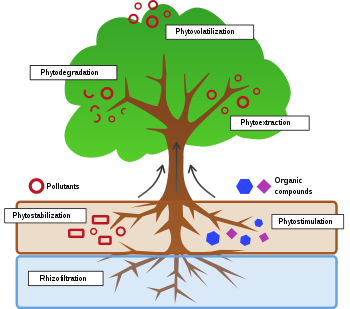
Phytoremediation
- Phytoremediation is use of plants for accumulation, removal or conversion of pollutants.
It also has different types like-
- Phytoextraction.
- Phyto transformation.
- Phyto stabilization.
- Phyto degradation.
- Rhizo filtration.
- Phytovolatization.
Important one liner on Solid Waste management.
What is solid waste?
A variety of discarded materials that result from the actions of humans and animals.
What are the sources of solid waste?
Agriculture, mining, residential, commercial, industrial, municipal services, institutional, and hospitals.
What are the types of solid waste?
Biodegradable, recyclable, inert, composite, and domestic hazardous/toxic waste.
Which sector produces the maximum share of solid waste?
Agriculture.
What are the steps involved in solid waste management?
Waste generation, collection, handling and separation, processing and transformation, transfer and transport, disposal, and energy generation.
What is the 3R concept?
Reduce, reuse, and recycle.
What are the different methods of waste disposal?
Solid waste open burning, sanitary landfill, incineration, composting, vermicomposting, pyrolysis, gasification, and bioremediation.
What is biogas?
A gas created through the breakdown of organic matter by bacteria in the absence of oxygen.
What is bioremediation?
A process in which organic wastes are broken down biologically under controlled conditions.
What are the organisms used in bioremediation?
Bacteria, fungi, and plants.